From bergamot to wintergreen: a field guide to classic flavor profiles
Hand a Swede something flavored with wintergreen and the usual reaction is a puzzled frown and a remark about a locker room. Hand an American something flavored with salty licorice and the reaction is often stronger. Neither of them is wrong. Each is reading a flavor through the foods they grew up with.
This guide is a field manual to the profiles that turn up again and again in flavored goods from the Nordic countries and North America: what each one is, which plant it comes from, which molecule carries its character, and how it reads to someone who did not grow up with it. It closes with a vocabulary for describing a flavor, a table of regional preferences across four markets, and a ten-point checklist for reading a flavor name without guessing.
1Why flavor names travel badly
A flavor name is a shortcut. "Mint" or "berry" on a label does not describe a molecule. It points at a shared memory, and it only works when the reader has that memory. The trouble is that memories of flavor are local. They are laid down in childhood by the sweets, the baking, the toothpaste and the soft drinks of one particular place.
That has three practical consequences, and the rest of this guide keeps coming back to them:
- The same word can mean two different flavors. "Mint" defaults to peppermint in most of Europe and very often to spearmint or wintergreen in the United States. "Cinnamon" is a soft baking spice in Stockholm and a hot red sweet in Chicago.
- The same flavor can carry opposite associations. Wintergreen is root beer and chewing gum to an American and a muscle rub to most Europeans.
- Some flavors have no local reference at all. Bergamot, cloudberry and salty licorice are everyday notes in Scandinavia and close to unknown in much of North America and Australia.
2Bergamot: the citrus nobody eats
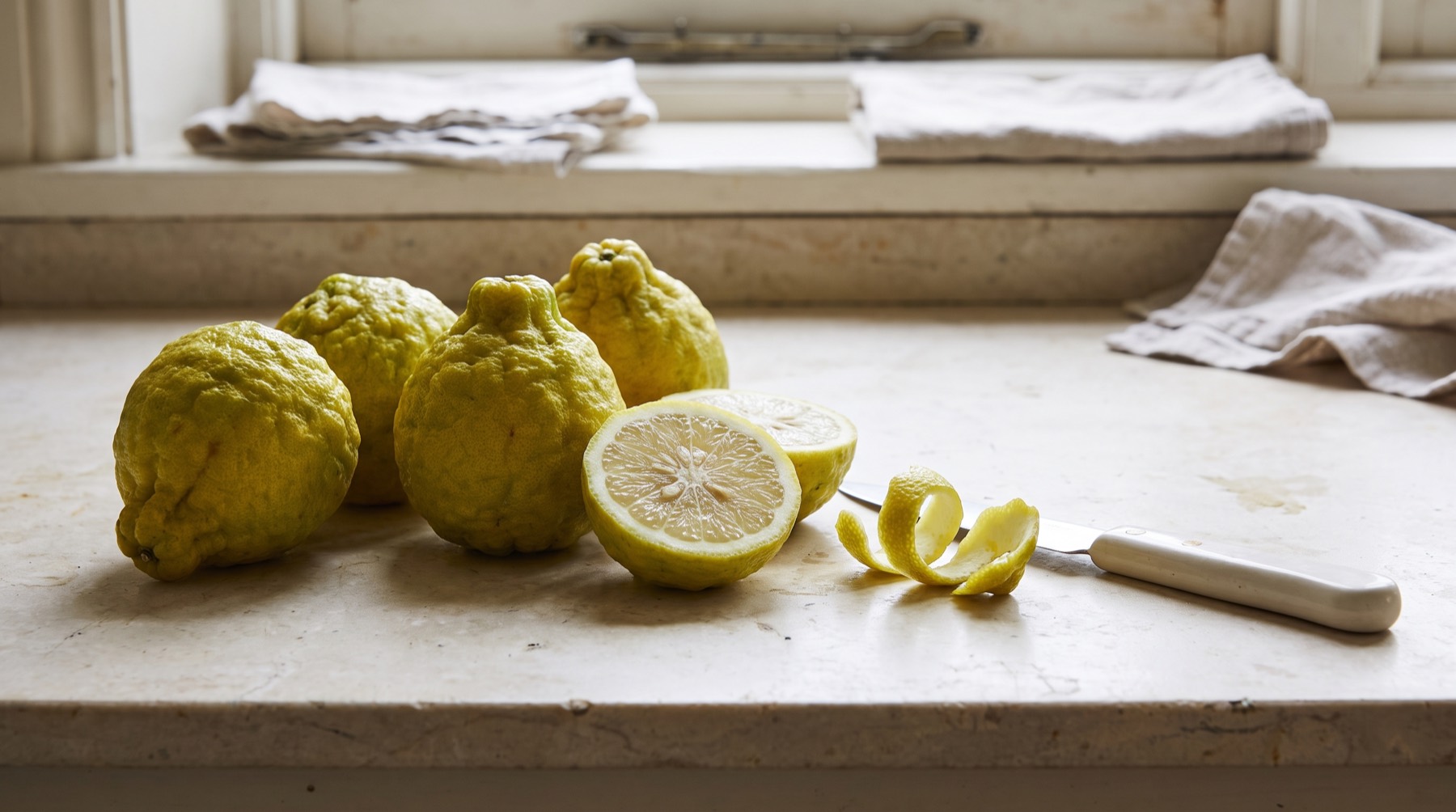
Bergamot is a citrus fruit grown almost entirely along one short stretch of coast in Calabria, at the toe of Italy. That narrow strip produces the large majority of the world's supply. The fruit itself is not eaten. It is grown for the oil pressed from its peel.
What makes that oil unusual among citrus is its balance. Lemon and orange oils are dominated by one compound, limonene, which gives a bright, simple, slightly sharp smell. Bergamot oil has limonene too, but it also carries a large share of linalyl acetate and linalool, the same compounds that define lavender. The result is a citrus that smells floral, soft and a little bitter at once. It is the note that makes Earl Grey tea taste like Earl Grey, and it has been a backbone of European perfumery since the first colognes of the early 1700s.
In Sweden, bergamot has been a signature of traditional flavoring for well over a century, to the point where many Swedes recognize it instantly without being able to name it. Outside Scandinavia, the same note is usually described by people as "like tea" or "like perfume," because those are the only places they have met it.
3Juniper and the taste of the forest
Juniper "berries" are not berries. They are the small fleshy cones of an evergreen shrub, and they take two to three years to ripen from green to a dusty blue-black. Crush one and the smell is immediate: resin, pine needles, pepper and a faint citrus edge.
The main compound responsible is alpha-pinene, the same molecule that gives a pine forest its smell, supported by sabinene and myrcene. Juniper is the defining flavor of gin, whose name is a worn-down form of the Dutch word for the plant. In Nordic kitchens it is a classic seasoning for game and for pickled and preserved fish.
As a flavor note, juniper does a job that few others can. It reads as dry and aromatic rather than sweet, which makes it a natural partner for bergamot: one supplies brightness, the other supplies depth. A pairing of the two is one of the oldest combinations in Scandinavian flavoring.
4Licorice, sweet and salty
Licorice is where the Nordic palate and almost everybody else's part ways. The flavor starts with the root of a plant in the pea family, which contains glycyrrhizin, a compound commonly estimated at thirty to fifty times sweeter than table sugar. Its sweetness behaves differently from sugar's: it arrives slowly, builds, and lingers long after the rest of the flavor has gone.
The aroma most people think of as "licorice" often comes from somewhere else entirely. Anethole is the molecule shared by anise, star anise and fennel, three plants that are not related to licorice or to one another. Much licorice confectionery is flavored with anise oil on top of the root extract, which is why the two are so hard to tell apart.
Then there is the salty kind. In Sweden, Finland, Denmark, Norway, Iceland, the Netherlands and northern Germany, licorice is routinely made with ammonium chloride, known as salmiak. It adds a sharp, tingling saltiness that is neither table salt nor sourness. To those raised on it, salmiak is a comfort flavor. To most first-time tasters elsewhere it is startling, and it is probably the single clearest example of a flavor that does not cross borders unassisted.
5Wintergreen: America's own mint
Wintergreen is not a mint at all. It is a low evergreen shrub that grows on the forest floor in eastern North America, and its flavor comes almost entirely from a single compound, methyl salicylate, which makes up nearly all of its oil. The bark of the sweet birch tree yields the same compound, which is why old American recipes use "birch" and "wintergreen" almost interchangeably.
The flavor is sweet, rounded and slightly creamy, with none of the sharp chill of peppermint. In the United States and Canada it is everywhere: in chewing gum, hard mints, toothpaste and, most famously, in root beer. Root beer was originally flavored with sassafras root. When the main aromatic compound in sassafras was removed from American food in 1960, wintergreen, vanilla, anise and licorice took over the recipe, and the taste most people now know as root beer is to a large extent the taste of wintergreen.
In Europe, methyl salicylate was never a food flavor of any importance. It was, and is, the smell of sports rubs and warming balms. That one difference in history explains why wintergreen is a nostalgic favorite on one continent and a hard sell on the other.
6Spearmint, peppermint and a mirror-image molecule
Peppermint and spearmint are both true mints, and peppermint is in fact a natural hybrid with spearmint as one of its parents. Their flavors come from different molecules. Peppermint is driven by menthol, which gives a sharp, cold impression. Spearmint is driven by carvone, which is sweeter, greener and barely cold at all.
Carvone carries one of the best-known curiosities in flavor chemistry. The molecule exists in two forms that are mirror images of each other, like a left and a right hand. One form smells of spearmint. The other smells of caraway and dill seed. Same atoms, same bonds, opposite handedness, and a completely different flavor.
Regional habit matters here too. In the United States, "mint" on a label very often means spearmint or wintergreen. In the Nordic countries and most of Europe it almost always means peppermint, usually a cold one. Two labels with the same word can describe opposite experiences.
7Cinnamon: one name, two barks, two traditions
What is sold as cinnamon comes from the inner bark of several related trees. The two that matter are Ceylon cinnamon, from Sri Lanka, and cassia, from China, Vietnam and Indonesia. They look different once you know what to look for. Ceylon cinnamon is a pale, crumbly quill rolled from many paper-thin layers. Cassia is a darker, harder, single thick curl.
Both owe their core character to cinnamaldehyde. Cassia has more of it and tastes hotter and blunter. Ceylon cinnamon is milder and more complex, with a clove-like note from a second compound, eugenol. Most cinnamon sold in North America is cassia.
The two traditions built on it could hardly be further apart. In Sweden, cinnamon is a baking spice, warm and buttery, celebrated every October 4 on a national day dedicated to the cinnamon bun. In the United States, cinnamon is just as often a confectionery flavor pushed to the hot end of its range: red, intense and close to burning. A Swedish reader and an American reader will picture two very different things from the same word.
8Coffee, vanilla and the roasted notes
A green coffee bean smells of almost nothing, something like dry grass. Everything recognizable arrives in the roaster. As the bean passes about 300 °F, its sugars and amino acids begin reacting with one another in the Maillard reaction, the same chemistry that browns bread crust and seared meat. Researchers have identified more than eight hundred aroma compounds in roasted coffee, and no single one of them smells like coffee on its own.
That complexity is why coffee is one of the hardest flavors to reproduce well. A convincing coffee note needs the roasted, slightly sulfurous top, the caramel-sweet middle and the bitter base to be present together and in proportion. Leave one out and it reads as burnt sugar or as mocha candy.
Coffee also has a geography. The Nordic countries are consistently among the heaviest coffee drinkers in the world per person, with Finland usually at the top of the list, and the Swedish coffee break has its own word, fika. Nordic coffee is traditionally roasted lighter than American or Italian coffee, so a "coffee" flavor designed in Stockholm tends to be brighter and less smoky than one designed in Seattle.
Vanilla sits beside coffee in the roasted family because it plays the same rounding role. Its key compound, vanillin, softens bitterness and makes other flavors read as sweeter than they are. It is one of the most widely used flavors in the world precisely because it is so rarely the star.
9Northern berries, and why purple is not the same everywhere
The Nordic forest has its own berry vocabulary, and little of it overlaps with the American one.
- Lingonberry. Small, red and sharply tart, with a slightly bitter finish. It is the standard partner to savory dishes in Sweden, in the way cranberry is in North America, and the two are close relatives.
- Cloudberry. Amber when ripe, growing wild in northern bogs and notoriously difficult to farm. The flavor is honeyed and tart at once, with a creamy note that people often compare to baked apple.
- Bilberry. The wild European blueberry. It is smaller than the cultivated American highbush blueberry, darker all the way through and noticeably more intense.
- Blackcurrant. Deep, tart and musky, with a distinctive sharp note produced by a trace sulfur compound. It is one of the best-loved fruit flavors in Britain, Scandinavia and Australia.
Blackcurrant also explains one of the oddest splits in flavor. In 1911 the United States prohibited growing blackcurrants, because the bushes carried a disease that threatened the timber industry's white pines. The federal rule was lifted in 1966, but by then two generations had grown up without the fruit. The slot it fills elsewhere was taken by Concord grape, whose candy-like character comes from a compound called methyl anthranilate. That is why a purple sweet tastes of grape in New York and of blackcurrant in London, Sydney or Stockholm.
10Citrus beyond lemon
Citrus flavors share a common base and differ in the details. In most citrus peel oils, limonene is by far the largest component, yet it has little character of its own. Identity comes from the compounds present in small amounts:
| Citrus | What gives it identity | How it reads |
|---|---|---|
| Lemon | Citral | Clean, sharp, instantly "lemony" |
| Lime | Citral with pine-like terpenes | Greener and more resinous than lemon |
| Sweet orange | Fruity aldehydes and esters on a limonene base | Round, sweet, juicy |
| Grapefruit | Nootkatone and a trace sulfur compound | Bitter, zesty, slightly musky |
| Bergamot | Linalyl acetate and linalool | Floral, soft, tea-like |
| Lemon myrtle | Very high citral content | "More lemon than lemon," with a sweet edge |
Indicative profiles as usually described in the flavor literature. Real oils vary with variety, harvest and how the oil is extracted.
Lemon myrtle deserves its own mention. It is not a citrus at all but an Australian rainforest tree whose leaves are exceptionally rich in citral, and it has become one of the signature native flavors of Australian food. It is a good reminder that a "citrus" flavor describes a smell, not a plant family.
11How a flavor unfolds: top, heart and base
Flavorists borrow three words from perfumery to describe how a flavor changes over time.
- Top notes are the first impression: small, light molecules that escape quickly. Citrus oils, the brightest part of a mint and fresh fruit esters live here. They are also the first to fade when something is stored warm or left open.
- Heart notes carry the identity. The floral side of bergamot, the body of a berry, the warmth of cinnamon and the sweetness of wintergreen are all heart notes.
- Base notes are the slow ones: vanilla, roasted coffee, licorice root, resinous juniper. They give depth and are what remains at the end.
A profile that is all top is exciting for a moment and then empty. One that is all base is heavy and dull. Most of the classic pairings in this guide work because they span the range: bergamot on top of juniper, citrus on top of mint, berry on top of vanilla.
12A vocabulary for describing a flavor
"It tastes nice" tells nobody anything. Tasting panels use a small set of dimensions, and anyone can borrow them to work out what they like and why.
| Dimension | The question | Typical terms |
|---|---|---|
| Family | Where does it sit on the wheel? | Citrus, mint, spice, roasted, berry, forest |
| Intensity | How loud is it at its peak? | Subtle, moderate, bold |
| Sweetness | Does it read sweet or dry? | Dry, balanced, sweet, candied |
| Temperature | Does it read cold, neutral or warm? | Icy, cool, neutral, warm, hot |
| Shape over time | Where is the weight? | Bright on top, rounded, long finish |
| Character | What does it remind you of? | Fresh, floral, resinous, creamy, tart, salty |
With these six words, "I like mint but not that one" becomes something useful: mint family, moderate intensity, sweet, neutral temperature. In other words spearmint or wintergreen, not a cold peppermint.
13The same shelf in four markets
Put the pieces together and a pattern appears. The table below summarizes the flavor references that readers in four markets are most likely to bring with them. It is a generalization, and every country contains every taste, but it explains most of the surprises people meet when they try flavored goods from somewhere else.
| Market | "Mint" usually means | Home-grown signatures | Often unfamiliar |
|---|---|---|---|
| Nordic countries | Cold peppermint | Bergamot, juniper, salty licorice, lingonberry, cloudberry, light-roast coffee | Wintergreen, root beer, Concord grape |
| United States | Spearmint or wintergreen | Wintergreen, hot cinnamon, root beer, Concord grape, dark-roast coffee | Bergamot, blackcurrant, salty licorice |
| Canada | Spearmint or peppermint | Maple, wintergreen, wild blueberry, saskatoon berry | Salty licorice, cloudberry |
| Australia | Peppermint or spearmint | Lemon myrtle, passionfruit, blackcurrant, eucalyptus | Wintergreen, root beer, juniper as a sweet note |
An editorial summary of common food and confectionery traditions, not survey data.
14Seven common misunderstandings
- "Wintergreen is a kind of mint." It is an unrelated shrub with a completely different key compound. It only shares a shelf with mint.
- "Licorice and anise are the same thing." They are unrelated plants. They overlap because anise oil is so often added to licorice sweets.
- "Bergamot is a herb." In flavoring it is a citrus fruit. A garden plant shares the name because its leaves smell similar.
- "Cinnamon is cinnamon." Ceylon cinnamon and cassia are different barks with different heat and different complexity.
- "Blueberry and bilberry are two names for one fruit." They are cousins. The wild European one is darker and more intense.
- "Juniper berries are berries." They are cones, from the same broad group of plants as pines and cypresses.
- "If I do not recognize a flavor, it must be artificial." More often it is simply regional. Somebody else grew up with it.
15A ten-point checklist for reading a flavor name
Before deciding what a flavor name means, it helps to ask:
- Which of the six families does it belong to, and does it lean toward a second one?
- If it says "mint," which mint: peppermint, spearmint or wintergreen?
- Where was the name written? A Nordic "mint" and an American "mint" are different defaults.
- Does it read cold, neutral or warm?
- Is it described as dry or sweet?
- If it names a berry, is it one you have actually tasted, or a regional one?
- If it says "citrus," is that lemon-sharp, orange-round or bergamot-floral?
- If it says "cinnamon," is that the baking spice or the hot confectionery version?
- Is it a single note, or a pairing with a bright top and a deeper base?
- Is your reaction to the flavor itself, or to what you associate it with at home?
None of these profiles is better than another. They are local languages, each perfectly clear to the people who grew up speaking it. Knowing where a flavor comes from, and what it means in the place it comes from, is most of what it takes to read a label accurately.